


Slippery slope
“Don’t sit there, Spud,” she gasped in a way that didn’t sound right at all. “If I slip, I don’t want to take you down with me.”

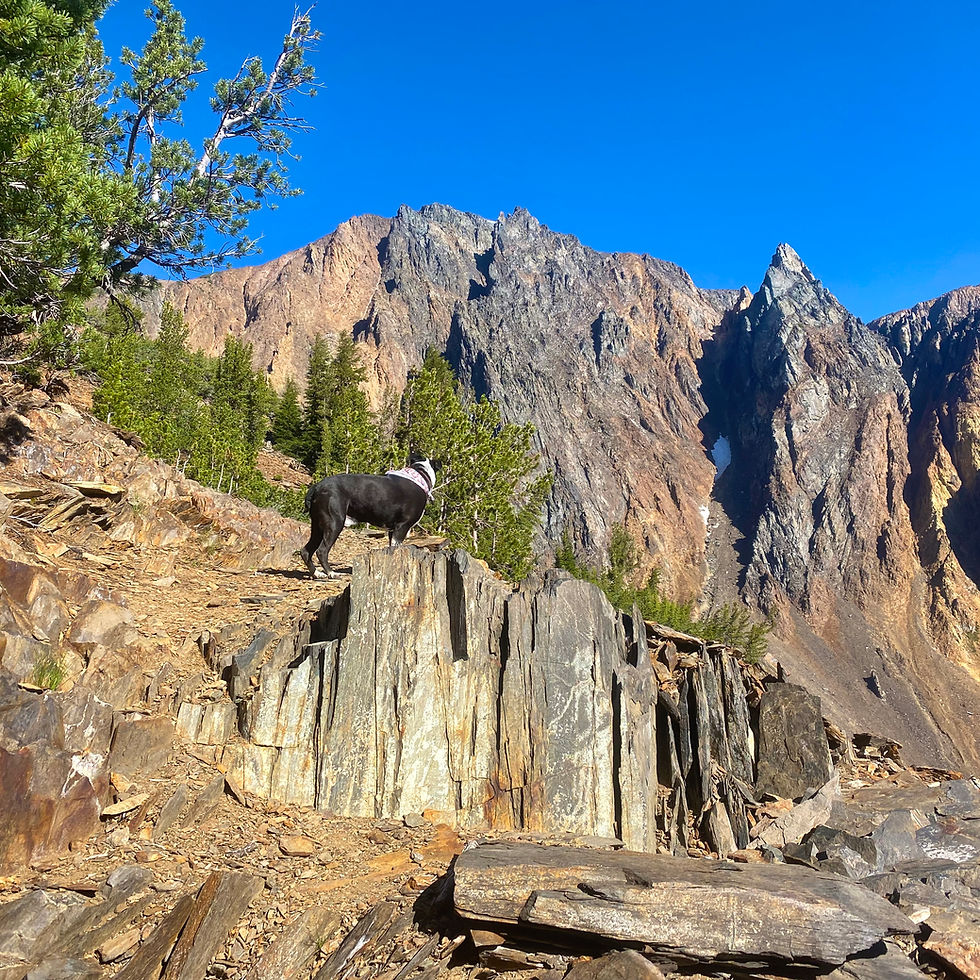
“Down where?” I peeked over my shoulder. From above, the slope looked a lot more like a cliff. It seemed impossible that we’d climbed so high moving so slowly. “I’ll go wherever you go. Please don’t leave me here alone.”
“Just stay next to me, okay? And don’t make any sudden moves.”
Mom tested the rocks under each of her paws before each step. Usually, she didn’t find the right balance on the first try, or the second, or the third. She grabbed each rock and shook it like a loose tooth, dropping the ones that came free by her side to trip and skip the rest of the way down the mountain until they finally settled with a crackle and a thump far, far below. Before long, it was taking Mom so long to find her next step that the three rocks she was standing on started to inch down the mountain before she found the fourth.
“Oscar! Get the duck out of the way!” she said in a strangled voice I’d never heard before.
I didn’t know what she meant since I was at her heels like a good boy, but I stepped aside anyway. When she finally moved her next foot uphill, the rock that it had been holding in place slipped loose. In no time, a herd of rocks was racing in a stampede down the mountain, taking the rock I’d just been standing on with them.
“Are you sure this is the trail?” I asked.
“I thought so at first,” Mom panted, “but now I think we’ve been following the path of a rockslide.”
“Why don’t we turn back? This seems like one of your bad ideas, and you’re no fun when you’re wrong.”
“I would love nothing more than to turn back, but when was the last time you looked down?”
I looked down again to see if there was something I was missing, but it looked just as get-me-outta-here scary on the second look as the first. This must be what the deer felt like right before they landed in the deer graveyard. Didn’t Mom, who’s so afraid of heights, see it too?
“It’s so loose, I don’t know how we’re gonna get down,” Mom choked. “I’m afraid if we put any downward momentum on these rocks, we’ll slip and fall.”

I took my eyes away from the bottom so I couldn’t imagine what Mom would look like splattered down there. Instead, I looked up to where the mountain gave way to sky. It was closer than the valley bottom, but not close enough. “Then why did you bring us all the way up here?”
“I didn’t realize we were off trail until a few minutes ago, and now we’re stuck. As dangerous as this is, I think the safest thing is to keep climbing. See, we’ve just got a few hundred feet to go.”
I sighed with relief. “Oh, I was scared for a second because I thought you didn’t have a plan. Lead the way!”
Instead, she told me to stay. Little by little, she moved sideways to the edge of the slide, where a little bit of solid mountain stuck through the shifty discard pile. She used the mountain like a ladder, pulling herself up one white-knuckled paw at a time and kicking away rocks that came loose under the pressure of her balance.
When she found a solid place big enough to sit, she called to me and it was my turn to find a route that worked for my paws. Once I was within patting range, I had to find a rock solid enough to stay on while Mom climbed the next section.
After a million lifetimes that ended in a million imaginary splats, Mom’s sharp sense of sight picked up the scent of the trail. It was on the other side of the steepest and slippiest part of the slide. And it was below us.
Again, Mom told me to stay while she kept climbing.

“The trail is below you, silly,” I thought after her, not daring to bark in case the force of it caused more of the mountain to come loose.
“If I go straight across, I’m going to slip and take half the mountain down on top of me.” She thought each word carefully, as if letting her thoughts move too quickly might send us both cartwheeling to the bottom. “The only way to cross is to keep going up and to the right until I’m above the trail.”
She kept moving slower than the glacier that created this mess until she made her way to the other side, where solid mountain again poked through the river of loose rock. She called me over and I tip-toed across stones hardly bigger than my paw. They made a sound like dishes as they shifted and slipped under me. Time didn’t speed up to its normal pace again until I was touching Mom. I sat so close that I was practically on top of her. Her fleshy bulk felt like the only solid thing on this mountain and I wanted as much of it holding me up as possible.
We leaned into each other, looking down at the trail not-that-close below us.“What now?” I asked.
“Sit behind me and go exactly where I go.” Mom waved her hand behind her to show where she meant. I tucked in so close that my toes scratched her butt and her shoulder blades scratched my chest.
We sat like a bobsled team with our hearts beating next to each other. Mom took a deep breath, and let the mountain take its course.
We used all eight of our legs as brakes as the mountain carried us down a slope as tall as a house and dropped us on the trail in a cloud of dust and smoke.
We stood on the solid ground for a long time, just making sure that we were both really alive. Mom crumpled down next to me and put her forehead on my forehead in that way that she does when she needs to block out everything but love. She plugged her fingers into the soft fur behind my ears, and told me she loved me once for every time she’d thought of death that morning. She kissed the spot between my eyes, put her forehead back on mine, and told me I was a good boy just as many times.
When all the trapped screams had finally melted from her mind, Mom stood up again and looked around.
“We’re going back down now, right?” I asked.
Mom followed the trail with her eyes until they lost track of it a short way below. It wasn’t much easier to spot from up here than it was when we lost it a lifetime ago.
“We must be 1,000 feet up,” she counted to soothe herself. “I need more time to calm down before I’m ready to try that again. Let’s see what’s at the top.”
We’d climbed so high trying to escape death that it only took a minute of normal walking to reach the top, where the trail was flat and the ground covered in serene lakes. It must have been a very lovely place in modern times, but with the smoke acting as a filter and fear still crackling in my veins, it felt more mominous.

I sat on a rock and watched the world fade. The boogeyvirus had taken so much: my officeful of collies, the smiles of new Friends, our freedom, and Mom’s invincibility. Now nature was disappearing, too. Perhaps the next time I left the Stuck House, there would be no wildness left at all, only witches and the lies that they spread.
“Is nature ruined?” I asked, searching the sparkle-less lake for signs of hope.
Mom looked where the sky was meant to be. “There’s been a lot of destruction, but it’s not ruined. Just injured enough to leave a scar.”
We watched together as the mountains on the far side of the lake faded like the Cheshire Cat, leaving only the outlines of sharp teeth in the gloom. After a while Mom said, “You know what it’s like to have a bee sting?”
It was a strange time to play the guessing game, but I played along anyway. “Surprising? When it’s okay to say bad words? Ouchie? Itchy? Puffy? Something to do with venom?”
“Itchy, right.” Mom picked absently at the scab on her arm. “When it’s irritated, you can’t think about anything else until you scratch it.”
“Duh. What else would you do with an itch?”
“Fires are a little bit like that—just a tiny pinpoint of inflammation in a vast world. They only seem bigger because you can’t think of anything else until they’re put out.” Her eyes stayed lost in the missing mountains as she picked slowly in time with her thoughts. I wondered if her mind was behind her fingers or her eyes. “Wildfires aren’t like housefires,” she went on. “Firefighters can’t put them out, only contain them.”
“Like scratching an itch,” I said. “But the more you scratch, the itchier it gets.”
“At least you feel like you’re doing something. And doing something is a kind of relief, even if it only distracts from the problems you can’t fix.” She picked off a scab and inspected the tender skin underneath. “I guess what I’m trying to say is that like everything else, no fire lasts forever. It seems like the most important thing in the universe when no one can control the spread and the world is filled with smoke, but we forget quickly when the fire is out and the smoke clears.”
“But if you scratch too much, you’ll get a scab that takes even longer to heal.”

“But at least you’re healing,” Mom said. “Maybe it isn’t good to move on too quickly, especially when relieving your discomfort creates a whole new set of problems to recover from. Maybe scars and charred logs remind us of what we learned during the times we’d rather forget.”
“As long as the itching is gone, you know you’re gonna be okay,” I encouraged.
“Yeah,” Mom said. I wondered if she was agreeing with me or her own thoughts. “But imagine it from the point of view of the bee. Something enormous and unexpected enters your world and it’s terrifying. You fight for your life, but no matter how brave you are, you’re gonna get swatted away. A minute or two later, you’ll die alone in the dust, far from your hive. The disaster will carry on, and your bravery won’t count for a damned thing.”
“Wait, are we the bee or the one getting stung?” I asked. “Are we still on fire?”
“I thought I was saying that this, too, shall pass.”
“I thought you were saying that you should be more chill and not blow your stinger on fights you can’t win.” I didn’t give her time to answer, in case that guess was wrong. “But how can we chill when smoke has erased the whole world and there’ll be nothing left when it’s over?”

“The smoke is filling our whole world, but it’s not everywhere. We’re so small and can only see such a short period of time that we can’t imagine these things at the scale that nature sees them. I bet there’s no trace of it in Peru, or Timbuktu. It’s blowing east, so we probably won’t even see it at the coast. All this smoke will be a distant memory by the time we get home.” She looked back toward where the land dropped away. “If we make it back home.” She scratched behind my ears and I leaned my head on her shoulder so she could get the right spot. “When we make it back home,” she decided. “What seems like the end of the world now is just a short irritation in the scheme of things.”
“But we live at the End of the World,” I reminded her.
“Which means there’s nothing west of us to burn. The rainy season starts in a few weeks, anyway. Then they’ll put the fire out and all this smoke will clear in no time. It’s here one day, gone the next. Afterward, we’ll see that everything we thought was lost was here all along.”
“Maybe we shouldn’t be here today so we’re not gone the next,” I said. “I mean, if the wilder-ness is so dangerous right now, shouldn’t we go wherever all the other hikers went until it’s safe?”
“I’m really not sure… This isn’t what we planned for, but the wilderness is uncontrollable. It’s like you said, if you only see it on its good days, aren’t you kind of missing the point? You need to see nature in action to appreciate its power, right?”
I chewed on that. I thought that’s how we’d always lived, but when I tried to come up with examples, I remembered plenty of trails that were still waiting for us because the white dirt was piled too high, or the Weather Jinx brought rain, or the trail was steep and turned Mom into a chicken. “Is that why people are such wimps?” I asked. “Because chickening out gives you something to look forward to?”
“What do you mean?”
“You people have it so good. You can open the Food Fortress all by yourself and buy hot dogs whenever you want. You get to go to an office and eat free snacks while you hang out with your Friends in meetings, or play on your keyboard for hours. You can drive wherever you want, and when you get there, people let you inside the buildings so you don’t have to wait in the car. No one ever takes your toys away as soon as you find the squeaker.” She served me a fistful of brunch to give herself time to remember why all that was a bad thing. “You talk about how stressful it is to have too much choice, but you complain when life makes a choice for you,” I went on. “The one time life took your choice away, you had a meltdown. Everyone did. With everything you can do, why get so bent out of shape the few times that life says no? Doesn’t Nature playing hard-to-get just give you something to look forward to?”
“I guess time feels so short and there are too many things to do.”
“You just said that we have all the time in the world. Isn’t it exciting to think about all the things that could possibly happen in that time?”
“Isn’t it disappointing how many things we’ll never get to do?”
“You can’t be disappointed if you don’t expect anything,” I said. “Look at me. I’m never allowed to do all that cool stuff without permission, so every time the Food Fortress opens its gates, it’s a delightful surprise.”
“I hate surprises,” Mom said. “You make it sound like freedom isn’t worth the responsibility that comes with it.”
“You know those pigeons in the City?” I asked.
“What about ’em?”
“Some of those guys are pretty messed up—missing feet and eyes and stuff. But I’ve never seen a pigeon sulking. They lose bits of themselves or they grow new lumpy bits that don’t belong, and they just say, This is my life now. Maybe I can use this peg leg to club Larry when we’re fighting over smashed chips outside the Taco Bell tomorrow. It’s no use complaining about the way things are.”
“Accept and adapt,” Mom said thoughtfully. “Like stoicism?”
But I was just warming up. I ignored her made-up words. “Everyone’s been so grouchy about the boogeyvirus because they didn’t plan for it and they can’t make it stop. So people do what they always do when they want to control something dangerous—they make rules about where the virus can and can’t go. They say that it’s in some stores, but not others. That it spreads by talking to strangers, but not your family. That it can only spread in parks with gates to lock. But the virus is wilder-ness, and wilder-ness doesn’t follow rules.”
“You forgot to mention how it’s not in bathrooms.”
“You can sulk about how other people are doing it wrong until you pee your pants, or you can be like a dog and get excited about everything you find rather than worried about everything you don’t know yet. If you refuse to do something until everything goes your way, you’ll be waiting for an awfully long time.”
“Okay, I promise. I won’t try to bend the world to fit my will anymore.” She looked at the sky. “Just please, please get us out of here safely.”
“Where to, then?”
“I was kind of hoping the problem would solve itself if we waited long enough.” She had let me sit at this lake for an awfully long time, despite it being so hard to breathe. “Let’s see if there’s a trailhead up here. Maybe we can hitchhike back to the van.”
“Don’t hitchhikers usually get murdered?” I asked.
“I’ll take my chances if it means not having to go back the way we came,” Mom gulped.
“Wouldn’t you rather die than ask someone for help?” I asked.
“It’s a tough choice.”
“Ha! You chumps!” the Witch interrupted. “There’s a parking lot a couple miles that way, but the road to get there is closed. You’re trapped!”
Want to keep reading? Grab Oscar’s book, No Place Like Alone on Amazon.


